
A New Wellness Service Scorecard for Salon Owners
An original worksheet for comparing salon wellness services while keeping missing information visible and essential requirements outside the weighted score.
Sources reviewed
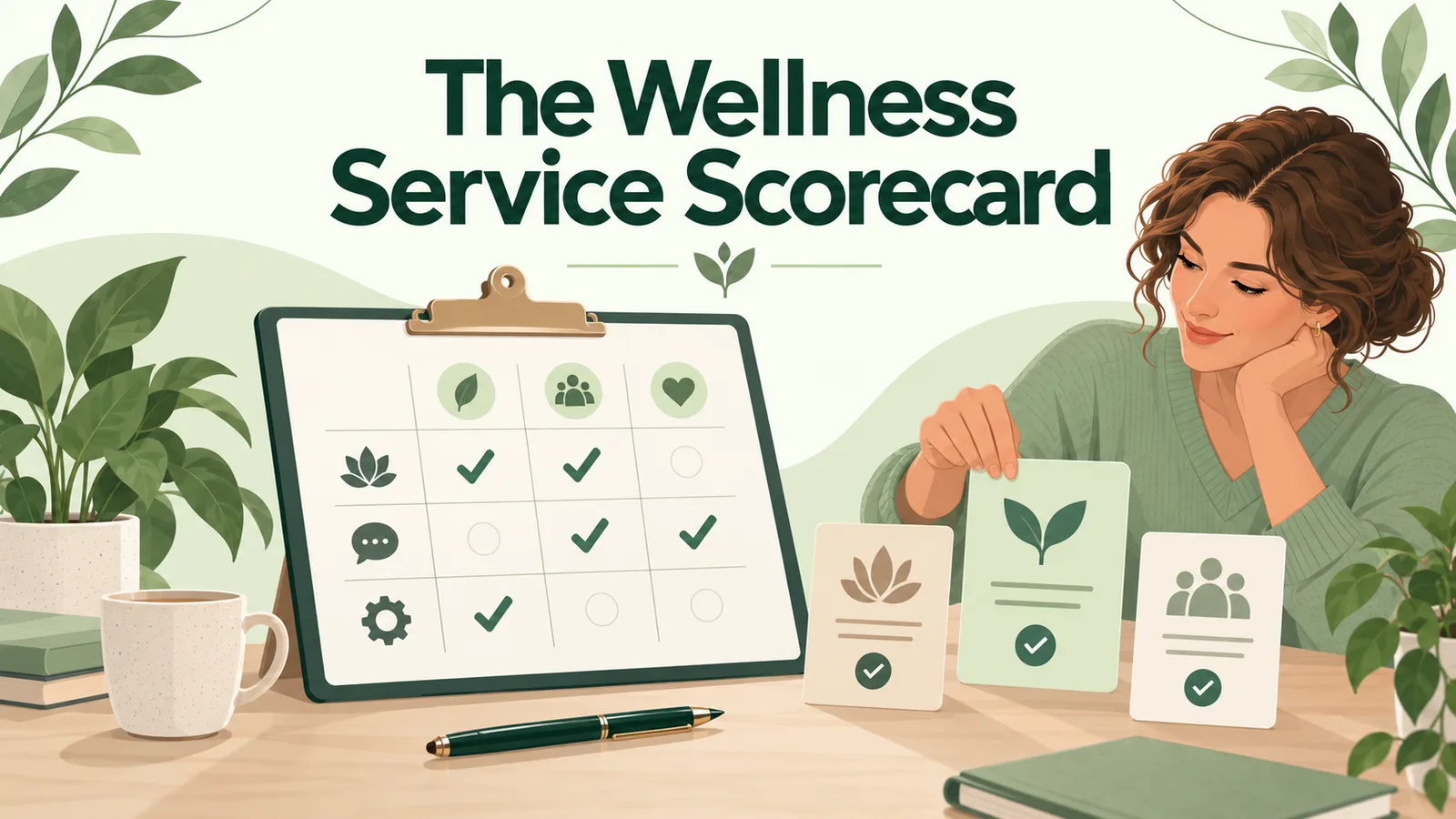
A salon wellness service scorecard helps you compare clearly defined options using shared criteria and evidence. It turns scattered supplier answers, room notes and client observations into a record you can discuss with your team. The result should explain your decision and remaining unknowns.
The tool combines six weighted criteria with separate essential checks, a blank worksheet and a worked example. The weights and decision bands are editorial starting points, not a validated model or a predictor of bookings, profit or health results.
Use the scorecard after you have described the service and its intended clients. The guide to choosing a service for existing salon clients helps with that earlier task. This worksheet organizes comparisons; it does not repeat the customer-research process or design a pilot.
Key Takeaways
- Score the exact appointment and provider offer, rather than a broad service label.
- Keep unknowns visible as zero with an “unknown” status; a confirmed mismatch is a different finding.
- Local permission, suitability, competent delivery and an approved budget are essential checks that override the total.
- Use the same weights and evidence standard for every candidate in one comparison.
- A high score can support a shortlist decision; it does not authorize launch or predict success.
Step 1: Define the decision before assigning points
Define the actual appointment, provider, room, complete visit and commercial offer, rather than a broad label such as “massage” or “wellness device.”
Create a separate record for each candidate. Score each configuration separately. Score only the scope included in the offer.
At the top of the sheet, record:
- Candidate: service name, provider and version of the offer.
- Client group: who the appointment is intended for.
- Delivery: add-on, separate booking, program or event.
- Site: proposed room and appointment window.
- Review: owner, review date and documents considered.
- Decision: what you are deciding now, such as whether to seek more information or prepare a limited test.
Comparing proposals is different from approving a deposit, fit-out or launch. The broader existing-business readiness guide helps identify responsibilities around that next stage.
Step 2: Check the essentials before interpreting the total
Use four essential checks outside the weighted score. Record each as pass, unknown or fail, with the source and who confirmed it. An unknown places the candidate on hold for the decision that depends on it. A fail means stop or redesign the offer, then assess the revised version.
| Essential check | What needs confirming | Status and evidence |
|---|---|---|
| Local permission and cover | Exact service, practitioner requirements, premises use and relevant insurance checked for the location | Pass / unknown / fail: ____; source: ____ |
| Suitability and safe delivery | Current instructions, client suitability process, escalation and any equipment/site checks are understood | Pass / unknown / fail: ____; source: ____ |
| Competent delivery | Required qualifications, task training, staff responsibilities and cover are established | Pass / unknown / fail: ____; source: ____ |
| Budget authorization | The owner has approved the stated spending limit and obligations for this decision | Pass / unknown / fail: ____; source: ____ |
A high provisional score cannot compensate for a failed or unknown essential check. You can still calculate a provisional score to see where more information is needed, but label the decision hold until the relevant checks are resolved.
Local requirements need their own sources. The US Small Business Administration's launch guidance explains that location affects licenses, costs and restrictions. It is US guidance, not a permission route for Europe, Canada or the Middle East. Use the appropriate local authority, insurer and qualified adviser for your premises and service.
For practitioner-led offers, NCCIH's credentialing guidance illustrates that practice requirements differ by jurisdiction and profession. A supplier's equipment demonstration is not automatic proof that every required qualification has been met.
Step 3: Use a shared scoring scale
Score each criterion from zero to four. Agree on the scale before reviewing proposals.
| Score | Anchor | Evidence standard |
|---|---|---|
| 0 | Missing or unknown | No usable answer; record “unknown” and the question to resolve |
| 1 | Confirmed poor fit | Evidence identifies a material mismatch with the stated requirement |
| 2 | Possible fit with open work | Some evidence exists, but an important assumption or change remains |
| 3 | Documented fit | Specific information supports the requirement without a material unresolved dependency |
| 4 | Checked strong fit | Documented fit has been checked against the actual site, team or client context by the appropriate person |
Zero preserves the missing answer; it does not prove the candidate is unsuitable. One records a supported mismatch. That distinction belongs in the evidence note as well as the number.
Do not award four because a brochure looks professional or a familiar brand gives reassurance. Record what was checked, by whom and against which requirement. For a client-relevance score of four, an appropriate check could be dated customer research reviewed against the defined offer, including its timing, price and attendance commitment. This is planning evidence, not proof of future bookings. Check supplier statements against your business requirements.
Step 4: Score six practical criteria
Weights sum to 100, emphasizing client relevance and workable delivery while including costs, support and clear communication.
| Criterion | Weight | What the evidence should address |
|---|---|---|
| Client relevance | 25 | A defined group has a credible reason to consider the exact experience, timing and price |
| Staff and appointment workflow | 20 | Preparation, delivery, interruptions, reset and cover fit the intended booking window |
| Space and privacy fit | 15 | Room access, movement, privacy, storage and any equipment needs fit the proposed setting |
| Cost clarity | 15 | One-time and recurring obligations are itemized; exclusions and material cost assumptions are visible |
| Provider support and continuity | 15 | Responsibilities, assistance, maintenance where relevant and replacement-staff arrangements are explained |
| Service explanation | 10 | Staff can accurately describe what is included, preparation, limitations and client questions without unsupported promises |
Use evidence appropriate to each model: an agreed substitute practitioner may support continuity for one offer, while repair arrangements may matter for another. Verify provider facts before scoring.
The equipment buying checklist can supply questions for device-based candidates. The staff onboarding guide supports your workflow review. Neither confirms what a particular provider includes.
Cost clarity is separate from the budget check. The budget check asks whether the owner has authorized the commitment. The score asks whether the information supporting that commitment is complete enough to compare. The SBA's planning guidance distinguishes one-time and recurring expenses; use local quotes and your own assumptions to make that distinction here.
Step 5: Calculate the score and keep unknowns beside it
For each criterion, calculate weighted points = weight × score ÷ 4. Add the six results to obtain a provisional evidence-supported score out of 100. Separately record the number of unknown criteria and their combined weight. Compare the unknown count and weight alongside totals: a lower score may reflect missing documentation rather than a worse service.
Do not remove unknown rows and divide by the remaining weights. That would make a partially documented candidate appear stronger by ignoring its missing information. Keep all six weights in the calculation.
Worked example: a hypothetical candidate
This example is invented to show the arithmetic. It describes no supplier, salon or Kenda result.
| Criterion | Weight | Hypothetical score | Weighted points |
|---|---|---|---|
| Client relevance | 25 | 3 | 18.75 |
| Staff and appointment workflow | 20 | 2 | 10.00 |
| Space and privacy fit | 15 | 3 | 11.25 |
| Cost clarity | 15 | 2 | 7.50 |
| Provider support and continuity | 15 | 0 — unknown | 0.00 |
| Service explanation | 10 | 3 | 7.50 |
| Provisional total | 100 | 55.00 |
The record also shows one unknown criterion, representing 15 weight points. Competent delivery remains unknown in the essential checks, so the decision is hold, regardless of the numerical total.
Suppose the owner later obtains suitable support documentation and checks the staffing plan. Support becomes three and workflow becomes three. The new provisional evidence-supported score is 71.25, calculated using the same weights. The owner still needs to resolve essential checks and decide what further work is justified. Documentation does not prove future demand or profit.
Step 6: Use decision bands as a discussion aid
The following bands are proposed editorial rules for this worksheet. They are not researched success thresholds. Set them before comparing candidates and apply them consistently.
| Provisional score | Suggested discussion outcome, if essential checks pass |
|---|---|
| Below 50 | Reconsider the fit or collect missing information before prioritizing this candidate |
| 50 to below 75 | Investigate the weaker or unknown criteria; keep the candidate provisional |
| 75 to 100 | Consider shortlisting for the next defined decision, with evidence and remaining conditions attached |
Read individual scores: room fit and client evidence need different checks.
If you change a weight, record the reason and rescore every candidate. You might place greater importance on privacy because your particular service requires it. Do not change weights after seeing totals merely to favor the option you already prefer. Any essential requirement remains outside this tradeoff.
Copy this blank owner worksheet
Copy for each candidate. Keep business notes here, without client names or personal health records.
Candidate and offer version: ____ Intended clients and appointment: ____ Site and booking window: ____ Review owner/date: ____ Essential checks: permission ____; suitability ____; competent delivery ____; budget ____
| Criterion | Weight | Score 0–4 | Evidence/status | Weighted points | Missing answer and owner |
|---|---|---|---|---|---|
| Client relevance | 25 | ____ | ____ | ____ | ____ |
| Staff and appointment workflow | 20 | ____ | ____ | ____ | ____ |
| Space and privacy fit | 15 | ____ | ____ | ____ | ____ |
| Cost clarity | 15 | ____ | ____ | ____ | ____ |
| Provider support and continuity | 15 | ____ | ____ | ____ | ____ |
| Service explanation | 10 | ____ | ____ | ____ | ____ |
| Provisional total | 100 | ____ /100 |
Unknown criteria/count and combined weight: ____ Decision and reason: ____ Next action, owner and review date: ____
Save the offer and evidence references with the worksheet. Date changes and preserve earlier versions. For a later approved test, use the separate wellness service pilot guide.
Frequently asked questions
Can I use this scorecard to compare Kenda with another option?
Yes, using the same criteria, weights and evidence standard for each exact offer. Do not award points for brand familiarity or assume that either provider includes a service without written confirmation.
Does a zero mean I should reject the service?
No. Zero marks a missing or unknown answer. Record the question and obtain evidence. A confirmed poor fit scores one; essential failures mean stop or redesign.
What if the highest score has an unresolved permission question?
Keep the decision on hold. Local permission is an essential check and cannot be traded against stronger scores elsewhere. Resolve the question with the appropriate source before taking the dependent action.
Can I change the weights for my salon?
Yes, if you explain the priorities and apply the revised weights to every candidate. Keep the sum at 100 and retain essential checks outside the total. The revised tool remains a judgment framework.
Will a score above 75 mean the service will be profitable?
No. The suggested band supports a shortlist conversation. Profitability needs its own documented costs, prices, capacity and demand assumptions. A readiness score is not a financial forecast or evidence of future bookings.
Finish with an explainable decision
A completed scorecard should show the candidate, evidence, unknowns, essential checks and next action. That record is more useful than choosing the highest number without understanding it.
If you are comparing a Kenda offer, begin with the public partnership overview and ask Kenda Global for current details. Request information for the exact service, site and market so that you can apply the same worksheet fairly to every option.